Microbiology Laboratory Turkey

Mikrobiyoloji Ile Ilgili Tüm Konuların Kısa ve Öz Anlatımları. Microbiology Lab Information.

Bu Blogda Ara(SEARCH)

MicroLab

parasitology etiketine sahip kayıtlar gösteriliyor. Tüm kayıtları göster

29 Mayıs 2019 Çarşamba

Mayıs 29, 2019

Dientamoeba fragilis

Dientamoeba fragilis

Dientamoeba fragilis was initially classified as an amoeba; however, the internal structures of the trophoziote are typical of a flagellate. No cyst stage has been described. The life cycle and mode of transmission of D. fragilis are not known. It has worldwide distribution. The transmission is postulated, via helminthes egg such as those of Ascaris and Enterobius species. Transmission by faecal- oral routes does occur. Most infection with D. fragilis is asymptomatic, with colonization of the cecum and upper colon. However, some patients may develop symptomatic disease, consisting of abdominal discomfort, flatulence, intermittent diarrhea, anorexia, and weight loss. 
The therapeutic agent of choice for this infection is iodoquinol, with tetracycline and parmomycine as acceptable alternatives. The reservoir for this flagellate and  lifecycle are unknown. Thus, specific recommendation for prevention is difficult. However, infection can be avoided by maintenance of adequate sanitary conditions. 

9 Mart 2019 Cumartesi

Mart 09, 2019

HYMENOLEPIS DIMINUTA (RAT TAPEWORM)

HYMENOLEPIS DIMINUTA
(RAT TAPEWORM)

Hymenolepis diminuta differs from Hymenolepis nana in that: 
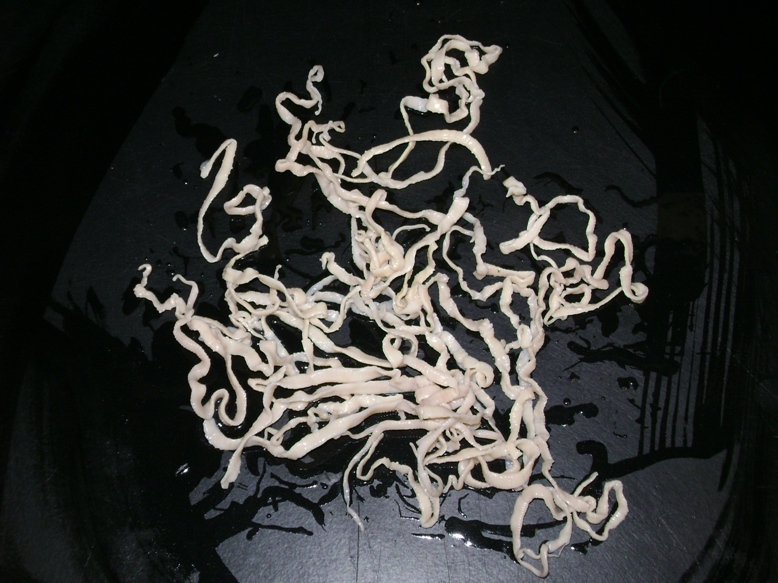
♦ The adult worm measures about 10-60 cm 
♦ The rosetellum on the head has no hooks 
♦ In the mature segment, there are two testes at one side and another testis on the other side.
Life Cycle
The adult worms are present in the small intestine of man and rats. Eggs passed in stool are similar to the eggs of H. nana but are brown in color with no polar filaments arising from the polar thickening. The eggs are ingested by the rat flea where they develop to cysticercoid stage. Infection to man takes place accidentally by food or contaminated hands by cysticercoid stage.
Pathogenecity
Most infections are asymptomatic, but occasionally, patients may present with nausea, anorexia and diarrhea.

Treatment
Same as Hymenolepis nana.

INSTAGRAM

1 Mart 2019 Cuma

Mart 01, 2019

Plasmodium ovale

Plasmodium ovale

P. ovale is similar to P. vivax in many respects, including its selectivity for young, pliable erythrocytes. As a consequence the classical characteristics include:  
• The host cell becomes enlarged and distorted, usually in an oval form.  
• Schiffner’s dots appear as pale pink granules.  
• The infected cell border is commonly fimbriated or ragged  
• Mature schizonts contain about 10 merozoites.

Epidemiology
P.ovale is distributed primarily in tropical Africa. It is also found in Asia and South America.

Clinical Features
The incubation period for P.ovale is 16-18 days but can be longer. Clinically, ovale malaria resembles vivax malaria with attacks recurring every 48-50 hours. There are however, fewer relapses with P.ovale. Less than 2% of RBCs usually become infected. 
Laboratory Diagnosis
Microscopic examination of thick and thin films of blood is the method of choice for confirming the clinical diagnosis of malaria and identifying the specific species responsible for disease. 

Malaria parasites in thick and thin blood films are best stained at pH 7.1 – 7.2 using a Romanowsky stain (contains azure dyes and eosin). 

The thick film is a concentration method that may be used to detect the presence of organisms.  The thin film is most useful for establishing species identification. Serologic procedures are available but they are used primarily for epidemiological surveys or for screening blood donors.
Immunity  
There is evidence that antibodies can confer hormonal immunity against malaria infection.   

Prevention  
• Chemoprophylaxis and prompt diagnosis and treatment.  
• Control of mosquito breeding  
• Protection of insect bite by screening, netting and protective clothing  
• Use of insect repellents.
Treatment
The treatment regimen, including the use of primaquine to prevent relapse from latent liver stages is similar to that used for P.vivax infection.

INSTAGRAM

22 Şubat 2019 Cuma

Şubat 22, 2019

Necator americanus

 Necator americanus

This species, so called American hookworm, is found in predominantly the tropics. The anterior end is hooked against the body curvature. The mouth is provided ventrally and dorsally with cutting plate.


Morphology
Male:
The male measures 8 cm in length. The posterior end is broadened into a membraneous copulatory bursa, which is provided with two long spicules fused distally.  

Female:
The female measures 10 cm in length. The posterior end is straight  
Infective stage and methods of infection: 
The filariform larva infects by skin penetration.


Life Cycle
Adult male and female worms live in the small intestine. The female lays eggs (oval, 60x40 microns), which contain immature embryo in the 4 cell stage. When the eggs pass in the stool to the soil and under favorable conditions of temperature, moisture and oxygen, they hatch into larvae, which molt twice and become infective. When the filariform larvae penetrate the skin, they circulate in the blood, reach the lungs, ascend to the trachea, descend to esophagus to reach the small intestine and become adults.


Pathogenecity
Adult worms in the intestine feed on blood causing iron deficiency anemia. The larvae may cause inflammation of the lungs. 
Diagnosis: 
Examination of stool by direct saline smear to detect the eggs.


INSTAGRAM

18 Şubat 2019 Pazartesi

Şubat 18, 2019

TAENIA SOLIUM (PORK TAPEWORM)

TAENIA SOLIUM


 The adult worms of T. solium reside or inhabit the upper jejunum. Infection has worldwide distribution.  


Morphology: 
Adult worm measures about 3 meters in length. The globular scolex has rostellum with 2 rows of hooklets. There are <1000 proglottids. Gravid proglottid liberates about 30,000-50,000 eggs. 
Life Cycle 
Embryonated eggs passed with stool are ingested by pig and the embryo is released. It penetrates the intestinal wall and is carried by vascular channels to all parts of the body. After a period of 2-3 months of development the encysted larval stage called cysticerci or bladder worm occurs in the striated muscles of the tongue, neck, trunk brain, eye, and the nervous system. The cysticercus survives for 5 years. Humans become infected by eating pork containing larvae, cysticercus cellulosae. When improperly cooked cysticercus infected meat is eaten by man, the scolex remains undigested and attaches itself to the intestinal wall and chain of proglottids begin to grow to adult worm.

Clinical Manifestations 
Resembles that of T. saginata infection.
Diagnosis 
Demonstration of eggs in stool specimen.


Prevention: 
♦ Treatment of infected persons. 
♦ Thorough cooking of pork and proper processing 
♦ Proper disposal of human excreta (good hygiene/sanitation).


INSTAGRAM

14 Şubat 2019 Perşembe

Şubat 14, 2019

Ancylostoma duodenale

Ancylostoma duodenale

Grayish-white in color. The body is slightly ventrally curved. The anterior end follows the body curvature. The buccal cavity is provided ventrally with pairs of teeth and dorsally with a notched dental plate.  Distribution: This species is found in the northern part of the world including China, Japan, Europe, North Africa and Ethiopia.

Morphology 

Male: 
The male measures 10 cm in length. The posterior end is broadened into a membraneous copulatory bursa that is provided with two long spicules. 

Female: 
The female measures 12 cm in length. The posterior end is straight. 


INSTAGRAM

11 Şubat 2019 Pazartesi

Şubat 11, 2019

Trichomonas Vaginalis (Trikomoniyaz)

Trichomonas Vaginalis
(Trikomoniyaz)

Trichomonas vaginalis, insanın ürogenital sistemine yerleşen kamçılı bir protozoon olup, parazitliğine trikomoniyaz denir. 

Trikomoniyaz toplumlarda yaygın bir cinsel yolla bulaşan (CYB) hastalıktır. Parazitin kaynağı enfeksiyonlu kadın ve erkeklerdir. Kadınlarda vajen, erkeklerde ise üretra etkenin en sıklıkla yerleştiği bölgelerdir. T. vaginalis ile enfekte kişiler devamlı olarak ürogenital salgıları ile bu kamçılı protozoonu etrafa yayarlar. Türkiye’de, hastalığın yaygınlık düzeyi tam olarak bilinmemektedir; değişik gruplarda yapılmış çalışmalarda farklı oranlarda pozitiflik görülmüştür. Trikomoniyaz CYB hastalıkların epidemiyolojik özelliklerini gösterir. Tedavi edilmeyen olgularda HIV enfeksiyonuna yakalanma riskini artırabilir.

Trikomoniyaz diğer CYB hastalıklar için bir “indikatör hastalık” gibi kabul edilmekte ve trikomoniyaz tanısı konan vakaların diğer CYB hastalıklar yönünden de araştırılması önerilmektedir ayrıca gebelerde erken doğumlara ve düşük ağırlıklı doğumlara neden olabilir. Eşlerin birlikte tedavi edilmesi gereklidir. 

Enfekte erkeklerde çoğu zaman semptom yoktur. Bazı olgularda idrar yaptıktan sonra ağrı ve yanma, penis içi irritasyon ve beyaz bulanık akıntı olabilir. Bazı (özellikle tedavisiz) olgularda da prostatit ve epididimite kadar ilerleyip, üretral daralma ve infertilite gibi sonuçlar doğurabilir. Bazı kadınlarda enfeksiyona ait herhangi bir semptom olmayabilir. Semptomlu olgularda; vajinal akıntı köpüklü, sulu, mukuslu, sulu süt renginde, beyazımsı, sarımsı, ender olarak yeşilimsi, pis kokuludur. Spekulum uygulaması ağrılıdır. Vajina ve vulvada şiddetli kaşıntı görülür. Semptomlar genelde bulaşma olduktan sonraki 5-28 gün içinde ortaya çıkar. 


INSTAGRAM

10 Şubat 2019 Pazar

Şubat 10, 2019

Giardia lamblia | Giardia intestinalis (Giyardiyaz)

Giardia lamblia | Giardia intestinalis (Giyardiyaz)

Bir protozoon olan Giardia intestinalis'in (Giardia lamblia) neden olduğu hastalığa Giardiyazis denir. Bu parazitin yaşam döngüsünde trofozoit ve kist formu bulunur. G. lamblia insana has bir parazittir.
Giardiyozda parazit kaynağı, vücutlarında bu paraziti barındıran insanlardır. Parazit, bu kişilerin dışkıları ile dışarı atılır. Dış ortamda trofozoitler yaşamlarını yitirirken kistler uzun süre canlı kalır. İnfeksiyon, parazitin dört çekirdekli olgun kistlerinin ağız yoluyla alınmasıyla oluşmakta ve on kadar kist bile enfeksiyona neden olabilmektedir. Bulaşık yiyecek ve içeceklerle veya bulaşlı parmaklarla ağızdan alınan Giardia kistleri mide ve bağırsak öz sularının etkisi ile açılırlar ve içlerinden açığa çıkan trofozoitler özellikle duedonum olmak üzere ince bağırsak çeperine yapışırlar. Mukozaya yapışan parazitler hem yapıştığı bölgedeki yüzeyi harap eder hem de o bölgedeki besin emilimini engeller. 


Giardia enfeksiyonları dünyanın her bölgesinde ve tüm yaş gruplarında görülebilmekle birlikte, bu parazitin yol açtığı hastalığa çocukluk yaşlarında daha sık rastlanmaktadır.


İnfeksiyon, semptomsuz seyredebileceği gibi kısa dönemli akut ishal veya vakaların çoğunda olduğu gibi yağlı, yumuşak dışkılama, karında şişkinlik ve gaz, kramp şeklinde karın ağrısı, epigastrik bölgede duyarlılık ve malabsorbsiyon sendromu gibi belirtilere neden olabilir.

Giardiyoz’un tanısı, dışkı örneklerinde kistlerin ve trofozoitlerin görülmesiyle konabilir. Tanı için ayrıca serolojik testler de yapılabilmektedir. 
Mutlaka tedavi edilmesi gerekmektedir.


INSTAGRAM

9 Şubat 2019 Cumartesi

Şubat 09, 2019

Plasmodium malariae

Plasmodium malariae

In contrast with P.vivax and P.ovale, P.malariae can infect only mature erythrocytes with relatively rigid cell membranes. As a result, the parasite’s growth must conform to the size and shape of red blood cell.  

This requirement produces no red cell enlargement or distortion, but it results in distinctive shapes of the parasite seen in the host cell, “band and bar forms” as well as very compact dark staining forms. The schizont of P.malariae is usually composed of eight merozoites appearing in a rosette.


Epidemiology  
P. malariae infection occurs primarily in the same sub-tropical and temperate regions as infections with the other plasmodia but is less prevalent. 


Clinical Features 
The incubation period for P. malariae is the longest of the plasmodia, usually 18 to 40 days, but possibly several months to years. The early symptoms are flu-like with fever patterns of 72 hours (quartan or malarial) in periodicity.  
Treatment  
Treatment is similar to that for P.vivax and P.ovale. 


INSTAGRAM