Microbiology Laboratory Turkey

Mikrobiyoloji Ile Ilgili Tüm Konuların Kısa ve Öz Anlatımları. Microbiology Lab Information.

Bu Blogda Ara(SEARCH)

MicroLab

30 Eylül 2018 Pazar

Eylül 30, 2018

ÜRE TESTİ (UREASE TEST)

ÜRE TESTİ (UREASE TEST)

Bu test, bakterilerin üreyi hidrolize eden üreaz (urease) enzimini belirlemek amacıyla yapılır. Bu bakteriler, üreaz enzim aktiviteleri ile üreyi parçalayarak karbondioksit ve amonyak oluşturur. Oluşan alkali ortamda, besiyerinin pembeye dönmesine neden olur.
Testte Christensen’in üre içeren besiyerleri (üreli buyyon veya agar) kullanılır.

Proteus mirabilis ve Klebsiella üreaz pozitif Escherichia coli negatif bakterilerdir.


Testin yapılış tekniği;

➨ Mikroorganizma kültürlerinden, petri kutusu veya tüpteki Christensen’in üreli agar yüzeyine tekniğine uygun ekim yapılır. 
➨ Etüvde, 37°C’de 1-5 gün inkübe edilir. 
➨ Renk değişmelerine dikkat edilerek her gün kontrol edilir. (Bazı durumlarda renk değişikliği 5-6 saat içinde meydana gelebilir.) 
➨ Kolonilerde veya tüpte pembe rengin meydana gelmesi pozitif reaksiyonu gösterir. 
Negatif durumda renk değişikliği olmaz.  


Üre Testi Pozitif Bakteriler

  1. Proteus spp
  2. Corynebacterium spp
  3. Helicobacter pylori
  4. Brucella spp


INSTAGRAM

FACEBOOK
29 Eylül 2018 Cumartesi

Eylül 29, 2018

IMVIC TEST (Indole Test, Methyl Red Test, Voges Proskauer Test and Citrate Test)

IMVIC TEST
 (Indole Test, Methyl Red Test, Voges Proskauer Test and Citrate Test) 


The IMViC Tests

The IMViC tests are used to differentiate the enterics (Family Enterobacteriaceae). These are the Indole test (tryptone broth), the Methyl Red and Voges-Proskauer tests (MRVP broth) and the Citrate test (Citrate agar slants). For these IMViC tests use the enterics E.coliand Enterobacter.

The significance of these tests is that when testing drinking water for the presence of the sewage indicatorE. coli, one must be able to rule out Enterobacter aerogenes.E. aerogenesis not always associated with sewage, and its presence in water would not necessarily indicate sewage contamination.

Indole Test (Tryptone broth)

Procedure: Inoculate a loopful of bacteria into a tryptone broth. Incubate 48 hours.

Description: Tryptophan hydrolysis -Some bacteria split tryptophan into indole and pyruvic acid using the hydrolase called tryptophanase. Indole can be detected with Kovac's reagent (Indole reagent). This test is very important in differentiating E. coli(indole positive) from some closely related enteric bacteria. It also differentiatesProteus mirabilis(indole negative) from all otherProteusspecies (indole positive). Tryptone broth is used for this test as it contains a large amount of tryptophan.

Interpretation: After incubation: The broth must be turbid. A clear broth indicates that your organism did not grow and cannot be tested. Add a few drops of Indole reagent to the broth culture (tryptone broth). DO NOT SHAKE THE TUBE. A positive result has a red layer at the top. A negative result has a yellow or brown layer.


Methyl Red Test (MRVP broth) 

Procedure: Inoculate a loopful of bacteria into MRVP broth. Incubate 3 to 5 days.

 Description: Mixed acid fermentation -Many gram-negative intestinal bacteria can be     differentiated based on the products produced when they ferment the glucose in MR-VP medium. Escherichia, Salmonella, andProteusferment glucose to produce lactic, acetic, succinic, and formic acids and CO2, H2, and ethanol. The large amounts of acids produced lowers the pH of the medium -Methyl red (a pH indicator) will turn red when added to the medium if the organism was a mixed acid fermenter. Many of these organisms also produce gas.

Interpretation: After incubation: The broth must be turbid. A clear broth indicates that your organism did not grow and cannot be tested. Remove 1 ml of broth and place into a sterile tube before performing the methyl red test ifyou are going to use the same broth for the VP test. Add 3-4 drops of methyl red to the original broth. DO NOT SHAKE THE TUBE. A positive result has a distinct red layer at the top of the broth. A negative result has a yellow layer.


Voges-Proskauer Test

Procedure: Inoculate a loopful of bacteria into MRVP broth. Incubate 3 to 5 days.

Description: Organisms that are negative in the methyl red test may be producing 2, 3 butanediol and ethanol instead of acids. These non-acid products do not lower the pH as much as acids do.Enterobacter, Serratiaand some species of Bacillus produce these substances. There is no satisfactory test for determining production of 2, 3 butanediol. A precursor of 2,3 butanediol called acetoin can be detected with Barritt's reagent.

Interpretation: After incubation: Read the VP test when you have good turbidity. A clear broth indicates that your organism did not grow and cannot be tested. Barritt's reagent A (VP A) contains naphthol and Barritt's B (VP B) contains KOH. Test 1 ml of your culture from the MRVP broth. If you have already conducted the methyl red test, you should have already placed 1 ml of untested broth in a sterile tube. If you haven’t done this, do so now. Add the entire contents of the VP A reagent (15 drops) and 5 drops of the VP B reagent to the 1 ml of your broth culture. SHAKE WELL. This reaction will take a few minutes before you will see a color change. SHAKE the tube every few minutes for best results. With a positive reaction the medium will change to pink or red indicating that acetoin is present. With a negative reaction the broth will not change color or will be copper colored. Wait at least 15 minutes for color to develop before calling the test negative.


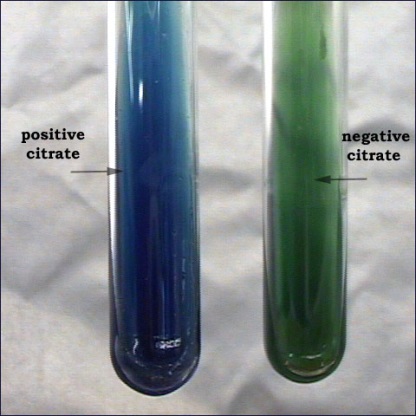
Citrate Test (Simmon's Citrate Slant)

Procedure: Streak a loopful of bacteria onto a citrate agar slant, do notstab the butt. Incubate 24 to 48 hours, longer forBacillus species. Incubate with a loose cap.

Description: Simmon's citrate agar tests for the ability of an organism to use citrate as its sole source of carbon. This media contains a pH indicator called bromthymol blue. The agar media changes from green to blue at an alkaline pH.

Interpretation: After incubation: A positive reaction is indicated by a slant with a Prussian blue color. A negative slant will have no growth of bacteria and will remain green.


    IMViC TEST


INSTAGRAM

FACEBOOK

28 Eylül 2018 Cuma

Eylül 28, 2018

IMVIC TEST

IMVIC TEST
(İNDOL, METİLEN KIRMIZISI, SİTRAT, VOGES TEST)


İndol Testi 

İndol, IMViC test grubu içinde yer alan testlerden biridir. IMViC testi; Indol, Metil kırmızısı, Voges - proskauer ve Sitrat (Citrat) testlerinin ilk harflerinden oluşur. Vi 'deki "i" küçük harf olarak yazılır ve sadece okuma kolaylığı sağlar. Bu testler, koliform grup bakterilerin (enterik bakterilerin) ayrımı için kullanılır. 

İndol testi; bakterilerin, bir aminoasit olan triptofanı ayrıştırarak indol meydana getirebilme yeteneğini belirlemek için kullanılır. Aynı zamanda, bakterilerin cins ve tür ayrımında kullanılır. İndol, bakterilerde bulunan triptofanaz enzimiyle bir aminoasit olan triptofanı parçalanması ve hidrolize etmesi sonucu oluşan nitrojenli bir bileşiktir ve aldehidlerle reaksiyona girdiğinde, kırmızı renkli bir ürün oluşturur. Salmonella’da indol pozitif, Proteus mirabilis’de negatiftir.

Testin yapılış tekniği; 
↱ İncelenecek bakteri kolonisinden özeyle alınarak temiz bir tüp içinde bulunan triptofan bulunan bir sıvı besiyerine ekim yapılır (buyyon veya peptonlu su)
↱ Tüpler etüvde, 37oC’de 1-5 gün inkübasyona bırakılır. 
↱ İnkübasyondan sonra üzerine, tüpün kenarından yavaşça akıtmak suretiyle 0,5 ml kovaks ayıracı ilave edilir ve tüp çalkalanır. Kovaks yerine Ehrlich ayıracı da kullanılabilir. 
↱ Renk değişimi gözlenir; 1-2 dakika içinde besiyerinin üst kısmında, parlak kırmızı bir halka oluşması, testin pozitif olduğunu (indol formasyonunu), sarımsı halka ise testin negatif olduğunu (indol oluşmadığını) gösterir.


Metil Kırmızısı Testi 

Metil kırmızısı testi, besiyerinde bakterilerin glukozu fermente edip organik asit oluşturarak besiyerinin pH'ını düşürme (4.4'ün altına) esasına dayanır. Bu test, bakterilerin cins ve türlerinin ayırt edilmesinde kullanılır. Metil kırmızısı testinde; Escherichia coli’de pozitif, Klebsiella pneumoniae’da negatiftir. 

Testin yapılış tekniği; 
➤ İncelenecek bakteri kolonisinden öze ile alınarak Glukoz-Fosfat Broth besiyerine ekim yapılır. 
➤ Tüpler etüvde, 37oC’de 1-7 gün inkübasyona bırakılır. 
➤ İnkübasyondan sonra üzerine 4-5 damla metil kırmızısı ayıracı damlatılır ve iyice karıştırılır. 
➤ Besiyerinde; kırmızı renk oluşması testin pozitif olduğunu, sarı renk oluşması ise testin negatif olduğunu gösterir.
➤ Metil kırmızısı ayıracı; pH 4.4 ve altında kırmızı renk, pH 6.0 ve üzerinde ise sarı renk verir. 


Sitrat Testi 

Bazı bakteriler karbon-enerji kaynağı olarak sitrat kullanır. Sitrat testi, bakterinin tek karbon kaynağı olarak sitratı kullanıp kullanmadığını, aynı zamanda bakterinin cins ve türlerini belirlemek için yapılır. Bakteriler tarafından sitratın metabolizması, citritase veya citrate demolase adı verilen enzimleriyle gerçekleşir. Klebsiella pneumoniae’da sitrat pozitif, Escherichia coli’de negatiftir. 

Testin yapılış tekniği;
➣ İncelenecek bakteri kolonisinden iğne öze ile alınarak tüpteki Simon’s Sitrat Yatık Agar besiyerinin yüzeyine ekim yapılır. 
➣ Tüpler etüvde, 37oC’de 2-7 gün inkübasyona bırakılır. 
➣ İnkübasyon sonunda, orijinal rengi yeşil olan ve indikatör olarak %0,2’lik Bromo timol mavisi kullanılan besiyerinde, besiyerinin rengi maviye dönüşür ve pozitif olarak değerlendirilir.


Voges - Proskauer (VP) Testi 

Bu test, bakteri türlerini belirlemede kullanılır. Bazı bakteriler, glikozu parçalayarak nötral bir ürün olan asetil metil karbinol (acetoin) oluşturur. Nöral ürünler identifikasyonda önemli göreve sahiptir. Asetil metil karbinol, potasyum hidroksid (KOH) varlığında okside olarak diasetil meydana getirir. Bu ürün ise alfa naftol (kreatin, arginin veya kreatinin) ile reaksiyona girdiğinde kırmızı renk oluşturur. Klebsiella pneumoniae’da pozitif, Escherichia coli’de negatiftir. 

Testin yapılış tekniği; 
⟹ İncelenecek bakteri kolonisinden öze ile alınarak tüpteki Glukoz-Fosfat Broth besiyerine ekim yapılır. 
⟹ Tüpler etüvde, 37oC’de 1-7 gün inkübasyona bırakılır. 
⟹ İnkübasyondan sonra üzerine, 1 ml %40’lık KOH, daha sonra 3 ml %5’lik alfa naftol ilave edilir ve karıştırılır. 
⟹ Besiyerinin hava ile temas etmesi için kuvvetli çalkalandıktan sonra 2-5 dakika içinde pembe-kırmızı renk oluşması testin pozitif olduğunu gösterir.


IMViC TEST 

INSTAGRAM

FACEBOOK

27 Eylül 2018 Perşembe

Eylül 27, 2018

CATALASE TEST

CATALASE TEST

Catalase is the enzyme that breaks down hydrogen peroxide (H2O2) into H2O and O2. The oxygen is given off as bubbles in the liquid. The catalase test is primarily used to differentiate between gram-positive cocci. Members of the genus Staphylococcus are catalase-positive, and members of the genera Streptococcus and Enterococcus are catalase-negative.


Performing The Catalase Test


1. Grow the isolate(s) to be tested for 18-24 hours on a BAP at 35-37°C with ~5% CO2 (or in a candle-jar). 

2. From overnight growth on the BAP, use a disposable loop to carefully remove a colony and place it on a glass slide. • Do not transfer any of the blood agar to the slide as erythrocytes in the blood agar will cause a false-positive reaction. 

3. Add 1.0 ml of 3% H2O2 to the slide and mix with the bacteria. 

• H2O2 can be obtained from a commercial drug store. 
• After initially opening, store H2O2 at 4°C in a tightly closed bottle as it will slowly lose potency once opened. 

4. Observe the bacterial suspension on the slide immediately for vigorous bubbling. 

5. It is essential to use a known positive and negative quality control (QC) strain. A Staphylococcus spp. strain can be used for a positive control and a known S. pneumoniae strain or any other streptococcal spp., i.e., S. pyogenes can be used for a negative control.


Reading the catalase test results 

• The absence of bubbling from a transferred colony indicates a negative test. 
• Any bubbling from a transferred colony indicates a positive test.

Procedure of Catalase test (Slide Test)

  1. Transfer a small amount of bacterial colony to a surface of clean, dry glass slide using a loop or sterile wooden stick
  2. Place a drop of 3% H2O2 on to the slide and mix.
  3. A positive result is the rapid evolution of oxygen (within 5-10 sec.) as evidenced by bubbling.
  4. A negative result is no bubbles or only a few scattered bubbles.
  5. Dispose of your slide in the biohazard glass disposal container.

Tube Catalase Test
  1. Add 4 to 5 drops of 3% H2O2 (Hydrogen peroxide) to in a test tube
  2. Using a wooden applicator stick, collect a small amount of organism from a well-isolated 18- to 24-hour colony and place into the test tube (Note: Be careful not to pick up any agar (esp if using Blood Agar).- Explanation in precaution below)
  3. Place the tube against a dark background and observe for immediate bubble formation (O2 + water = bubbles) at the end of the wooden applicator stick.


                                                Performing The Catalase Test


INSTAGRAM

FACEBOOK
https://m.facebook.com/mikrobiyolojilab/                                

26 Eylül 2018 Çarşamba

Eylül 26, 2018

KATALAZ TESTİ

KATALAZ TESTİ

Katalaz bir enzim olup, çoğunlukla aerobik mikroorganizmalar tarafından oluşturulur. Bu enzim, ortamdaki hidrojen peroksiti su ve oksijene ayrıştırır.


Aerobik ve pek çok fakültatif anaerobik mikroorganizma katalaz enzimine sahiptir. Stapylococcus, Micrococcus, Proteus, E.coli, Pseudomonas ve Bacillus katalaz pozitif bakterilere örnek gösterilebilir. Streptococcus, Leuconostoc, Lactobacillus gibi Laktik asit bakterileri ve Clostridium’lar genelde katalaz negatif bakterilerdir (bazı laktik asit bakteri suşlarının özellikle kan içeren besiyerinde katalaz testine pozitif netice verdiği bilinmektedir).

Sıvı veya katı bakteri kültürlerine H2O2 ilave edildiğinde, serbest oksijenin gaz kabarcıkları halinde gözlenir hale gelmesi, hidrojen peroksitin ayrışmasını, dolayısıyla da katalazın varlığını gösterir. 

Staphycoccusları, Streptococcuslardan ayırt edebilmek için besiyerinde oluşan hemoliz, koloni ve gram boyamanın özellikleri yeterli değildir. Bu ayrımı yapabilmek için katalaz testi kullanılır. Katalaz, streptokokların dışında birçok aerobik ve fakültatif bakteri tarafından üretilen bir enzimdir. Katalaz enzimi, eritrositlerde de bulunduğundan dolayı; test edilecek bakteri kolonisi, kan içermeyen bir besiyerinden alınır. 

Katalaz testinde, süspanse bakteri kolonisine hidrojen peroksit (H2O2), damlatarak katalaz enzimini tespit etmek amaçlanmaktadır. Sıvı ve katı besiyerlerinde üremiş bakterilere H2O2 ilave edildiğinde, oksijenin kabarcıklar halinde çıkması H2O2’nin ayrıştığını, dolayısıyla katalaz enziminin varlığını gösterir. Staphylococcuslar’da katalaz pozitif, Streptococcuslar’da ise katalaz negatiftir. 

Test, tüpte veya lamda olmak üzere iki şekilde yapılır.


 Tüpte katalaz testi
→ İncelenecek bakteri kolonisinden özeyle alıp temiz bir tüp içinde, bir
damla serum fizyolojik ile süspanse edilir.
→ Üzerine %3’lük H2O2 damlatılır ve karıştırılır.
→ Karışım içinde oksijenin açığa çıkması yani, hava kabarcıklarının
oluşması testin pozitif olduğunu gösterir.


Lamda katalaz testi 
⟹ İncelenecek bakteri kolonisinden özeyle alınarak temiz bir lam üzerinde, bir damla distile su ile süspanse edilir. 
⟹ Üzerine %3’lük H2O2 damlatılır ve karıştırılır. 
⟹ Karışım içinde oksijene bağlı köpürme-hava kabarcıklarının oluşması, testin pozitif olduğunu gösterir. 

                                 
Katalaz test sonucu (-) ve (+) 

Değerlendirme
 Hidrojenperoksid katılmasından sonra kabarcıkların görülmesi veya çıkması pozitif reaksiyon olarak değerlendirilir. Şüpheli durumlarda mikroskop altında muayene yapılabilir. Reaksiyon en iyi pH 7.0 da meydana gelir ve oda sıcaklığında yapılır. Sonuçlar, negatif (-), zayıf (+), orta (++) ve kuvvetli (+++) pozitif olarak derecelendirilir.

                                                 KATALAZ TESTİNİN YAPILIŞI
                                    

INSTAGRAM
FACEBOOK
Eylül 26, 2018

GRAM STAINING

GRAM STAINING

What is Gram Staining?
Gram staining is a common technique used to differentiate two large groups of bacteria based on their different cell wall constituents. The Gram stain procedure distinguishes between Gram positive and Gram negative groups by coloring these cells red or violet. Gram positive bacteria stain violet due to the presence of a thick layer of peptidoglycan in their cell walls, which retains the crystal violet these cells are stained with. Alternatively, Gram negative bacteria stain red, which is attributed to a thinner peptidoglycan wall, which does not retain the crystal violet during the decoloring process.


Gram-staining Procedure

Gram-staining is a four part procedure which uses certain dyes to make a bacterial cell stand out against against its background. The specimen should be mounted and fixed on a slide before you procede to stain it. The reagents you will need to successfully perform this operation are:
  • Crystal Violet (the Primary Stain)
  • Iodine Solution (the Mordant)
  • Decolorizer (ethanol is a good choice)
  • Safranin (the Counterstain)
  • Water (preferably in a squirt bottle)

⧫ Before starting, make sure that all reagents, as well as the squirt-bottle of water, are easily accessible because you won't have time to go get them during the staining procedure. Also, make sure you are doing this near a sink because it can get really messy. Wear a lab coat.


STEP 1: Place your slide on a slide holder or a rack. Flood (cover completely) the entire slide with crystal violet. Let the crystal violet stand for about 60 seconds. When the time has elapsed, wash your slide for 5 seconds with water. The specimen should appear blue-violet when observed with the naked eye.

STEP 2: Now, flood your slide with the iodine solution. Let it stand about a minute as well. When time has expired, rinse the slide with water for 5 seconds and immediately procede to step three. At this point, the specimen should still be blue-violet.

STEP 3: This step involves addition of the decolorizer, ethanol. Step 3 is somewhat subjective because using too much decolorizer could result in a false Gram (-) result. Likewise, not using enough decolorizer may yield a false Gram (+) results. To be safe, add the ethanol dropwise until the blue-violet color is no longer emitted from your specimen. As in the previous steps, rinse with the water for 5 seconds.

STEP 4: The final step involves applying the counterstain, safranin. Flood the slide with the dye as you did in steps 1 and 2. Let this stand for about a minute to allow the bacteria to incorporate the saffranin. Gram positive cells will incorporate little or no counterstain and will remain blue-violet in appearance. Gram negative bacteria, however, take on a pink color and are easily distinguishable from the Gram positives. Again, rinse with water for 5 seconds to remove any excess of dye.


After you have completed steps 1 through 4, you should blot the slide gently with bibulous paper or allow it to air dry before viewing it under the microscope. DO NOT RUB THE SMEAR!


INSTAGRAM
https://www.instagram.com/microbiologylab_turkey/

FACEBOOK
https://m.facebook.com/mikrobiyolojilab/

Eylül 26, 2018

GRAM BOYAMA

                                        GRAM BOYAMA 

Gram boyama tekniği, mikrobiyolojide sık kullanılan bir boyama yöntemi olup mikroorganizmaların sınıflandırılmasında ve tanımlanmasında kullanılır. Gram boyama ile bakteriler “gram pozitif’ (gram olumlu) ve “gram negatif’ (gram olumsuz) olarak ikiye ayrılır.

Basillerin yaklaşık yarısı, kokların büyük kısmı ve mantarlar gram pozitiftir. Spiral şekilli bakteriler ise gram negatiftir. Gram pozitif bakterilere örnek olarak Staphylococcus aureus, Bacillus subtilis, Staphylococcus epidermidis verilebilir. Gram negatif bakterilere örnek olarak E.coli, Pseudomonas aeruginosa, Etıterobacter aerogenes verilebilir. Gram boyama için hazırlanacak preparatlarda kullanılacak kültürlerin genç (18-24 saatlik) olması gerekir. Daha yaşlı kültürlerle çalışılması durumunda yanlış sonuçlar alınabilir. Gram (+) bakteriler de gram (-) gibi değerlendirilebilir.

                                Gram boyama aşamaları ve her aşamada bakterilerin renkleri 

En sık uygulanan gram boyama yönteminde aşağıdaki işlemler sırasıyla uygulanır: 
⇒ 1,2’de belirtildiği şekilde preparat hazırlanır (yayma, kurutma, tespit).
⇒ Preparatın üzerine kristal viyole boya çözeltisi eklenerek kaplanır ve 1 dakika beklenir.
⇒ Preparat bol distile suyla yıkanır.
⇒ Preparatın üzerine lugol çözeltisi eklenerek kaplanır ve 1 dakika beklenir.
⇒ Preparat distile suyla yıkanır.
⇒ Preparatın üzerine %95’lik etanol veya asit-alkol karışımı eklenerek 10-15 saniye beklenir.
⇒ Preparat distile suyla yıkanır.
⇒ Preparatın üzerine sulu fuksin veya safranin boya çözeltisi eklenerek kaplanır ve 30 saniye beklenir.
⇒ Preparat bol distile suyla yıkanır.
⇒ Preparat havada veya kurutma kâğıdı ile kurutulur.
⇒ Mikroskopta incelenir. Mor renkte görülen mikroorganizmalar gram (+), pembe-kırmızı renkte görülenler ise gram (-) olarak değerlendirilir.

Gram (+) ve gram (-) mikroorganizmaların tamamı kristal viyole boyası ile mor renge boyanırlar. Preparata eklenen lugol solüsyonu ile gram (+) bakterilerin oluşturdukları yapı, daha sonra ortama eklenen alkol ile giderilemez. Oysa gram (-) bakterilerin oluşturduğu yapı alkol ile giderilebilir. Bir başka deyişle, boya, bakteri hücresinden dışarıya salınır (dekolorizasyon).

Gram (-) bakterilerin renkleri alkolle gittiğinden ortama daha sonra eklenen sulu fuksin ile boyanır. Böylece gram (+) bakteriler mor renkte (kristal viyole rengi), gram (-) bakteriler pembe-kırmızı renkte (sulu fuksin rengi) boyanır.
Gram pozitif ve graın negatif hücre duvarı
Gram boyanma özelliği bakteri hücre duvarının (çeperi) yapısı ile ilgilidir. Hücre duvar yapıları arasındaki farklar: 
➨ Gram (+) bakterilerin hücre çeperinde gram (-) bakterilere göre daha kalın peptidoglikan tabakası mevcuttur. 
➨ Gram (+) bakterilerin hücre çeperinde karbonhidratlar, gram (-) bakterilerin hücre çeperinde lipidler fazladır. Karbonhidratlar alkolle dekolarizasyon esnasında dehidratasyona (su molekülünün açığa çıkması) uğrar. Porlar iyice büzüşür, daralır ve boya dışarı çıkamaz. Lipitler de ise alkol çözücüdür ve hücre çeperinde olan porlar daha çok açılarak genişler. 
➨ Gram (+) hücre çeperinde teikoik asit olmasına rağmen gram (-) yoktur.